What Is the Difference Between Weight Carrying and Weight Distributing Hitches?
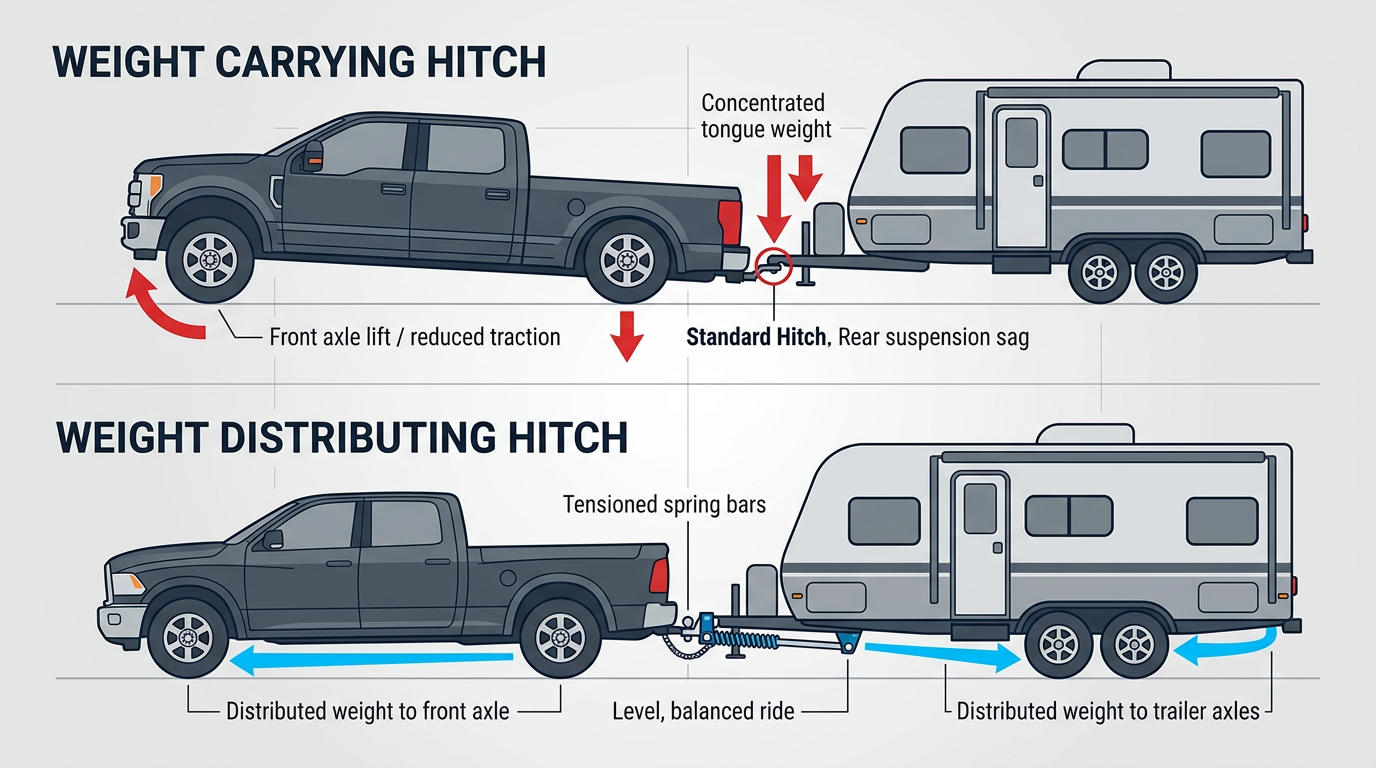 A weight carrying hitch supports a trailer's entire tongue weight directly on the rear hitch ball and rear axle of the tow vehicle. A weight distributing hitch uses spring bars and leverage to leverage tongue weight forward to the front axle and backward to the trailer axles, keeping both vehicle and trailer level during travel.
Standard Weight Carrying Setup:
[ Tow Vehicle Front Axle ] -------- [ Rear Axle ] === ( Hitch Ball ) <--- [ Concentrated Tongue Load ]
                                       ^ Sags under load

Weight Distributing Setup:
[ Tow Vehicle Front Axle ] <======= [ Rear Axle ] === ( Hitch Ball ) ======= [ Trailer Axles ]
       ^ Restored weight                   Spring Bars Apply Leverage             ^ Shared load
When a trailer connects to a standard weight carrying receiver, the downward load forces the rear suspension down while lifting the front wheels upward. This upward pivot reduces front-tire traction, lightens steering control, and alters brake performance. A weight distribution system solves this leverage problem by using rigid spring bars under tension. These spring bars act as levers, pushing down on the trailer frame and lifting up on the hitch head, which re-establishes balanced weight across all tire contact patches.
Understanding these mechanical differences is essential for maintaining safety, tire wear, and vehicle longevity when pulling heavy loads. Drivers hauling campers or utility trailers to Smithville Lake frequently encounter rear-end sag when relying solely on a standard ball mount. Our service team at Smithville Ford, LLC helps owners evaluate their trailering hardware to match their vehicle's exact Gross Vehicle Weight Rating (GVWR) and Gross Trailer Weight (GTW). If you want expert help inspecting your hitch receiver assembly or verifying your vehicle frame connections, visit our service center location or give our technicians a call at (816) 532-0800 to discuss your towing setup.
Table of Contents
- How Weight Distribution Shifts Tongue Load and When You Need It
- What Hitch Class Is Required for a Weight Distribution System?
- How Does Sway Control Work on a Weight Distributing Hitch?
- Can You Use Air Bags or Helper Springs Instead of a Weight Distributing Hitch?
- How Does a Weight Distributing Hitch Compare to Gooseneck and Fifth-Wheel Hitches?
- Frequently Asked Questions About Trailer Hitches and Towing Equipment
- Essential Towing Equipment Maintenance for Local Drivers
How Weight Distribution Shifts Tongue Load and When You Need It
A weight distribution hitch alters load distribution by converting vertical tongue weight into rotational torque across the vehicle frame. Rather than letting the trailer tongue sit as a dead weight on the bumper, tensioned spring bars lever part of the downward force forward toward the front suspension and backward toward the trailer's tandem axles.
| WEIGHT DISTRIBUTION LEVERAGE DYNAMICS |
|---|
| Upward Force on Front Axle Upward Force on Trailer Axles |
| ^ ^ |
| [ Front Suspension ] <==== ( Spring Bars ) ====> [ Trailer Axles ] |
| v |
| Downward Torque at Hitch |
You should install a weight distribution hitch whenever your trailer's gross weight exceeds 5,000 lbs or whenever your trailer weight surpasses 50 percent of your tow vehicle's gross vehicle weight rating. Key visual and mechanical indicators that signal the need for weight distribution include:
- The rear bumper of the tow vehicle sags noticeably below its normal stance when hitched.
- The front headlamps tilt upward, casting light above the road surface.
- The front steering feels loose, light, or slow to respond during turns.
- The trailer sways in crosswinds or when passing large highway traffic.
Using a weight distribution hitch allows your vehicle to pull up to its maximum rated weight distribution capacity safely without over-stressing the rear coil or leaf springs. Vehicles equipped with a 3.5L engine and SelectShift® automatic transmission, like the 2026 Ford F-150 with a maximum towing capacity of 10,400 lbs, rely on balanced load distribution to preserve transmission life, wheel bearing integrity, and braking distance.
Our technicians routinely verify frame-mount hardware and torque specifications on weight distribution brackets. For replacement hardware or OEM towing components, drivers can order directly through our official OEM parts catalog.
What Hitch Class Is Required for a Weight Distribution System?
A weight distribution system requires a Class 3, Class 4, or Class 5 receiver hitch rated specifically for weight distribution use. Class 1 and Class 2 receiver hitches feature 1.25-inch receiver openings that lack the structural strength to handle the rotational leverage created by spring bars.
| Hitch Class | Receiver Size | Standard Weight Carrying Capacity | Weight Distribution Capacity | Recommended Applications |
|---|---|---|---|---|
| Class 3 | 2-inch | Up to 8,000 lbs GTW / 800 lbs TW | Up to 12,000 lbs GTW / 1,200 lbs TW | Full-size SUVs, mid-size and half-ton trucks |
| Class 4 | 2-inch | Up to 10,000 lbs GTW / 1,000 lbs TW | Up to 12,000 lbs GTW / 1,200 lbs TW | Half-ton and three-quarter-ton pickup trucks |
| Class 5 XD | 2-inch | Up to 17,000 lbs GTW / 2,550 lbs TW | Up to 17,000 lbs GTW / 2,550 lbs TW | Three-quarter-ton and one-ton heavy-duty trucks |
| Class 5 CD | 2.5-inch | Up to 20,000 lbs GTW / 2,700 lbs TW | Up to 20,000 lbs GTW / 2,700 lbs TW | Commercial chassis cab and dually trucks |
Before attaching a weight distribution shank, always verify the rating label affixed directly to your receiver tube. Receiver safety stickers list two distinct ratings: weight carrying (WC) capacity and weight distribution (WD) capacity. If a receiver label does not explicitly list a weight distribution capacity, that receiver is not designed to accept spring bar leverage and must never be used with a weight distribution kit.
Mid-size SUVs like the 2026 Ford Explorer equipped with a 2.3L engine, SelectShift® transmission, and a towing capacity of 5,000 lbs feature factory Class 3 receivers that accommodate lighter weight-carrying ball mounts or lightweight weight distribution setups within their specified rating limits.
How Does Sway Control Work on a Weight Distributing Hitch?
Mechanical friction devices in sway control systems reduce side-to-side trailer movement, enhancing stability during towing. By damping lateral movement at the pivot point, sway control prevents side winds, passing semi-trucks, and quick steering adjustments from initiating dangerous trailer oscillations.
Sway control mechanisms generally fall into three main mechanical categories:
- Friction Sway Control Bars: These units utilize a friction pad sliding inside a steel housing attached between the trailer frame and a auxiliary ball mounted on the hitch head. Tightening an adjusting bolt increases resistance against lateral sliding.
- 2-Point and 4-Point Integrated Systems: These systems integrate sway suppression directly into the spring bar brackets. Rigid steel brackets or friction pads create continuous resistance whenever the spring bars try to pivot during a turn.
- Dual-Cam Mechanical Systems: Dual-cam setups lock spring bars into rounded saddle cams. When the trailer attempts to sway off-center, the spring bars must ride up the curved cams against heavy spring tension, forcing the trailer back into straight alignment behind the truck.
Proper maintenance of sway control systems is critical. Friction pads wear down over time and require periodic thickness checks and adjustments to ensure effective damping force.
When servicing towing equipment, our technicians ensure that all sway brackets are located at the precise distance along the trailer A-frame specified by the manufacturer, preventing binding during tight low-speed turns.
Can You Use Air Bags or Helper Springs Instead of a Weight Distributing Hitch?
Air bags and helper springs cannot replace a weight distribution hitch because they only support vertical load at the rear axle without transferring leverage weight to the front suspension or trailer axles. While auxiliary suspension components level the vehicle chassis visually, they do not resolve the mechanical weight unbalance affecting steering and front braking.
| SUSPENSION AIR BAGS vs. WEIGHT DISTRIBUTION |
|---|
| AIR BAGS / HELPER SPRINGS: |
| - Lifts the rear chassis visually |
| - Concentrates 100% of tongue weight on the rear axle |
| - Leaves front axle lightened, steering unassisted |
| - Does not supply trailer sway control |
| WEIGHT DISTRIBUTION HITCH: |
| - Restores level ride height through mechanical leverage |
| - Shifts weight forward to front axle and back to trailer axles |
| - Restores front tire grip, braking force, and steering control |
| - Integrates built-in lateral sway dampening |
Installing rear air bags inflates the space between the rear axle and frame, pushing the truck body up to eliminate visual sag. However, the trailer's downward leverage still rests entirely on the rear axle and tires. The front wheels remain lightened, meaning front steering grip and front braking force stay compromised.
In contrast, a weight distribution system uses spring bar leverage to press down on the front axle, restoring front suspension geometry, headlight alignment, and tire contact patches. Air bags are ideal for handling heavy cargo loaded inside the truck bed, but when towing a heavy bumper-pull trailer, a weight distribution hitch is the mechanically proper component for load levelling and directional control.
How Does a Weight Distributing Hitch Compare to Gooseneck and Fifth-Wheel Hitches?
A weight distribution hitch connects to a frame-mounted bumper-pull receiver at the back of the vehicle, while gooseneck and fifth-wheel hitches mount directly inside the truck bed above or slightly ahead of the rear axle. This structural placement fundamentally changes how the tow vehicle supports trailer weight.
| HITCH ATTACHMENT LOCATIONS COMPARED |
|---|
| Bumper-Pull Weight Distribution: |
| [ Front Axle ] ------------------------- [ Rear Axle ] ===== ( Receiver Hitch ) |
| ^ Lever Point |
| Gooseneck & Fifth-Wheel: |
| [ Front Axle ] -------------------- ( Hitch Ball / Kingpin ) --- [ Rear Axle ] |
| ^ Weight Over Axle |
A weight distribution hitch cannot handle higher tongue weights than a fifth-wheel hitch. A top-tier bumper-pull weight distribution setup tops out at approximately 2,000 lbs to 3,000 lbs of tongue weight and a maximum gross trailer weight around 15,000 lbs to 20,000 lbs. In comparison, a fifth-wheel hitch supports pin weights reaching 7,500 lbs or more and gross trailer weights exceeding 30,000 lbs.
| Feature | Weight Distribution Hitch | Gooseneck Hitch | Fifth-Wheel Hitch |
|---|---|---|---|
| Mounting Location | Rear bumper receiver | Inside truck bed over rear axle | Inside truck bed over rear axle |
| Coupling Mechanism | Standard hitch ball and coupler | 2-5/16-inch hitch ball and coupler | Jaw mechanism and kingpin |
| Max Tongue / Pin Weight | Up to ~ 3,000 lbs | Up to ~ 7,500 lbs | Up to ~ 7,500 lbs |
| Max Trailer Weight | Up to 15,000 lbs – 20,000 lbs | Up to 38,000 lbs | Up to 30,000 lbs |
| Primary Use Case | Travel trailers, boat trailers | Livestock trailers, flatbeds | Heavy travel trailers, fifth-wheels |
Fifth-wheel and gooseneck systems place the load directly over the rear axle, eliminating the long leverage overhang that creates rear-end sag on rear-receiver setups. For heavy commercial hauling or large agricultural equipment moves through Trimble, a heavy-duty truck setup like a 2026 Ford Super Duty paired with a fifth-wheel or gooseneck hitch offers the structural capacity required for extreme pin loads.
Frequently Asked Questions About Trailer Hitches and Towing Equipment
Q: How do I know if my receiver hitch supports a weight distribution system?
Check the metal safety identification label welded to the hitch receiver tube under your rear bumper. This sticker clearly displays two distinct sets of ratings: weight carrying (WC) capacity and weight distribution (WD) capacity. If the label only lists weight carrying capacity, the receiver is not structurally designed to support weight distribution spring bars and must not be used with one.
Q: Can I use a weight distribution hitch on a trailer equipped with surge brakes?
You must select a weight distribution hitch specifically rated for surge brake compatibility. Standard chain-style weight distribution systems can restrict the forward and backward sliding motion of a surge brake actuator on the trailer tongue, preventing the hydraulic brakes from engaging. Specialized weight distribution heads feature sliding trunnion channels that allow the actuator to compress freely during deceleration.
Q: Do I need to unhook my weight distribution spring bars when backing up or parking?
Basic friction-style sway control bars should be unhooked or loosened before making sharp low-speed turns or backing into tight parking spots to prevent binding and metal fatigue. Modern 2-point and 4-point integrated weight distribution systems designed with built-in spring bar brackets allow complete freedom of movement and do not require disconnects when reversing or maneuvering at low speeds.
Q: Will installing a weight distribution hitch increase my vehicle's towing limit?
A weight distribution hitch does not increase the overall maximum towing limit established by your vehicle's manufacturer. It allows you to safely utilize the maximum weight distribution capacity of your receiver hitch and vehicle chassis by restoring level ride height and front-axle traction, but it never overrides the vehicle's published gross combined weight rating.
Q: How often should towing hardware and spring bar brackets be inspected?
Inspect all hitch pins, mounting bolts, spring bar retention clips, and frame brackets before every towing trip. Check torque levels on receiver mounting hardware and trailer frame brackets every 5,000 miles. Look for signs of metal fatigue, elongated pin holes, or worn friction pads to ensure your towing setup operates safely throughout the season.
Essential Towing Equipment Maintenance for Local Drivers
Proper trailer hitch selection and ongoing equipment maintenance are critical for keeping your tow vehicle safe and dependable on the road. Whether you pull a travel trailer for weekend camping trips or haul farm equipment across local rural routes, maintaining your receiver assembly, inspecting sway control friction pads, and verifying tongue weights prevents premature wear on your vehicle's suspension and drivetrain.
Our factory-trained technicians at Smithville Ford provide comprehensive towing system inspections, custom hitch installations, and trailer brake controller setups tailored to your specific vehicle. We verify frame torque values, check receiver tube clearances, and assist with spring bar adjustments to ensure your truck sits level under load.
If you have questions about your vehicle's towing limits or need professional help setting up a weight distribution system, visit our Smithville dealership location or call our service department at (816) 532-0800. You can also get started today by scheduling your service appointment online to keep your towing setup running strong for every trip.
© 2026 Smithville Ford, LLC. All rights reserved.