What Is Included in a Complete Trailer Towing Setup?
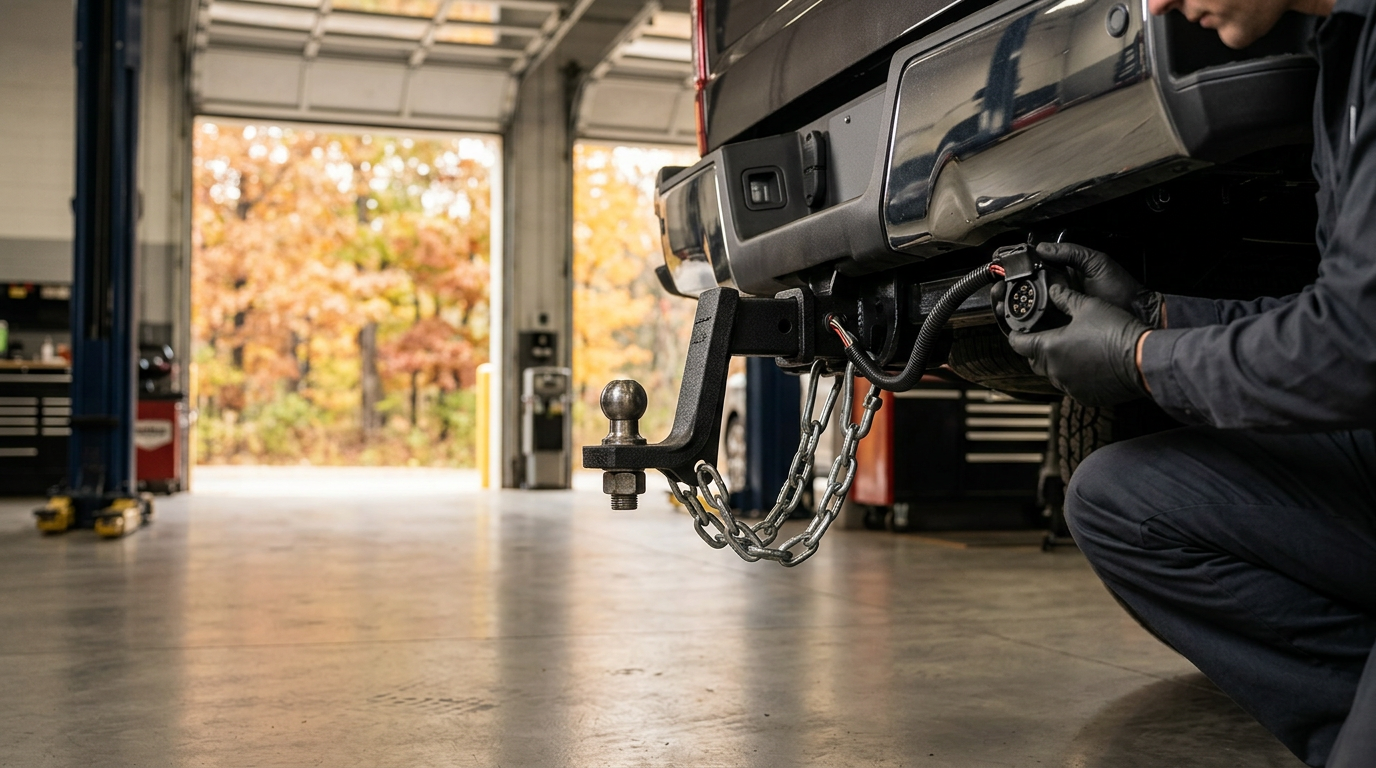 A complete trailer towing setup requires a vehicle-mounted receiver hitch, a ball mount with an appropriately sized hitch ball, heavy-duty safety chains, a trailer wiring harness (4-pin or 7-pin), an integrated trailer brake controller, and upgraded vehicle cooling systems. Together, these components securely connect your trailer, deliver electrical signals for trailer lighting and electronic braking, and maintain engine and transmission stability under heavy loads.
Setting up a vehicle for towing involves far more than simply bolting a hitch to the rear bumper. Safe hauling requires a balanced system where mechanical strength, electrical power, and thermal management work seamlessly together. The structural anchor of the entire system is the receiver hitch, which attaches directly to the frame of your vehicle. Into this receiver tube slides the ball mount, held in place with a hitch pin and clip. The hitch ball sits on the ball mount, providing the pivot point where the trailer coupler secures.
Electrical connectivity is equally critical for safety on public roads. A basic 4-pin wiring harness supplies signal power for tail lights, brake lights, and turn signals. For heavier loads requiring electric trailer brakes, a 7-pin connector provides additional circuits for auxiliary power, backup lights, and electric brake actuation. An integrated trailer brake controller inside the cabin allows the driver to adjust and monitor braking force applied to the trailer wheels.
Beyond the hitch and wiring, heavy towing demands extra protection for your vehicle's mechanical components. Hauling a boat out to Smithville Lake adds significant thermal strain on your powertrain. A complete setup includes essential cooling upgrades—such as auxiliary transmission oil coolers and upgraded radiators—to keep fluid temperatures within safe operating ranges. If you are preparing your vehicle for seasonal hauling, our technicians can evaluate your frame hardware and electrical connections at our Smithville location or answer any service questions when you give our team a quick call.
Table of Contents
- What Is the Difference Between a Factory Tow Package and a Trailer Hitch?
- What Size Receiver Tube Does Each Hitch Class Use?
- How Do You Calculate Payload Capacity Versus Towing Capacity?
- What Is Tongue Weight and What Percentage Should It Be of Total Trailer Weight?
- How Do You Properly Measure and Adjust Hitch Height for Level Towing?
- How Do Integrated Trailer Brake Controllers and Ford Towing Tech Work?
- Common Questions About Trailer Towing Equipment and Maintenance
- Keeping Your Tow Vehicle and Equipment Ready for the Road
What Is the Difference Between a Factory Tow Package and a Trailer Hitch?
A trailer hitch is simply the physical receiver unit mounted beneath the rear frame, whereas a factory tow package is a comprehensive engineering suite built into the vehicle to handle heavy pulling stresses. A standalone hitch provides an attachment point for lightweight accessories, but a full factory package upgrades the vehicle's engine cooling, transmission, suspension, rear axle ratio, and electrical control systems.
Understanding this distinction helps vehicle owners avoid costly mechanical strain. Installing an aftermarket receiver hitch allows you to attach a bike rack or pull a small utility trailer. However, a hitch alone does not increase how much weight your truck can pull safely. Without the underlying cooling and mechanical upgrades included in a factory equipment package, pulling heavy loads can cause transmission overheating, excessive engine wear, and brake fatigue.
Factory-installed options, such as the Tow/Haul Package available on the Ford F-150, incorporate heavy-duty hardware configured specifically for hauling. These packages typically include:
- A heavy-duty frame-mounted Class IV trailer hitch receiver.
- A 7-pin and 4-pin combined wiring harness assembly.
- An upgraded engine cooling fan and high-capacity radiator.
- An auxiliary transmission fluid cooler to manage thermal buildup.
- An upgraded rear axle ratio, such as a 3.55 or 3.73 electronic-locking rear axle, to maximize low-end pulling torque.
- Integrated software enhancements, including trailer sway control and specialized transmission shift logic.
If your vehicle came equipped with a standard receiver but lacks complete wiring or brake control systems, retrofitting original manufacturer components ensures proper system integration. You can inspect genuine hardware accessories and electrical assemblies directly through our online parts catalog to ensure your vehicle maintains factory reliability.
What Size Receiver Tube Does Each Hitch Class Use?
Receiver tube sizes correspond directly to hitch classes, starting at 1-1/4 inches for lightweight passenger vehicles and reaching up to 3 inches for commercial-grade heavy-duty trucks. Matching your hitch ball mount to the correct receiver tube dimension is essential for structural stability and proper load rating alignment.
Trailer hitches are categorized into five distinct classes based on maximum gross trailer weight ratings and receiver tube opening dimensions. Choosing the proper class ensures your towing equipment matches your vehicle's rated capacity without creating dangerous mechanical weak points.
- Class 1: Uses a 1-1/4-inch receiver tube. Rated for light loads up to 2,000 lb of gross trailer weight, common on compact cars and crossovers for bike racks or small cargo trays.
- Class 2: Uses a 1-1/4-inch receiver tube. Rated for up to 3,500 lb, typical for midsize crossover vehicles pulling light utility trailers.
- Class 3: Uses a standard 2-inch receiver tube. Rated for up to 8,000 lb conventional towing (or higher with weight distribution), commonly equipped on full-size SUVs like the Ford Expedition and light-duty pickups.
- Class 4: Uses a 2-inch receiver tube with reinforced steel construction. Rated for up to 12,000 lb to 14,000 lb, ideal for large ski boats, travel trailers, and heavy equipment trailers pulled by full-size trucks.
- Class 5: Uses a 2-1/2-inch or 3-inch receiver tube. Rated for heavy-duty application pulling up to 20,000 lb conventional loads or higher on commercial chassis models like the Ford Super Duty.
Inserting a smaller ball mount shank into a larger receiver tube using reducer sleeves can introduce excess play, noise, and vibration. Always select ball mounts designed specifically for your receiver tube size to maintain rigid engagement while hauling on country roads and highway routes.
How Do You Calculate Payload Capacity Versus Towing Capacity?
Payload capacity dictates the total weight your vehicle can support directly inside the cab and bed, while towing capacity measures the maximum weight your vehicle can pull behind it. To calculate your remaining available payload, subtract the weight of all passengers, cargo, aftermarket accessories, and the trailer's tongue weight from your truck's Gross Vehicle Weight Rating (GVWR).
Confusing payload with towing capacity is one of the most common oversights truck owners make. Every vehicle has strict manufacturer ratings established for overall safety, axle longevity, and stopping capability:
- Gross Vehicle Weight Rating (GVWR): The absolute maximum allowable total weight of the vehicle itself, including driver, passengers, fuel, cargo, equipment, and trailer tongue weight.
- Gross Combined Weight Rating (GCWR): The maximum allowable total combined weight of the loaded vehicle and the loaded trailer together.
- Payload Capacity: The total weight capacity available for cabin occupants, bed cargo, and tongue weight.
- Towing Capacity: The total pulling limit established by engine torque, cooling capacity, frame strength, and axle capability.
For example, if a truck has a GVWR of 7,000 lb and a curb weight of 5,000 lb, its maximum payload capacity is 2,000 lb. If you add 800 lb of passengers and gear into the cabin, you have 1,200 lb of payload capacity remaining. Because trailer tongue weight counts directly against vehicle payload, a heavy travel trailer exerting 900 lb on the hitch ball leaves only 300 lb for additional cargo inside the bed.
When pulling agricultural equipment or livestock trailers around Trimble, calculating payload properly prevents overloading rear axles and rear suspension leaf springs. Exceeding payload limits compromises steering responsiveness, causes premature tire wear, and lengthens stopping distances.
What Is Tongue Weight and What Percentage Should It Be of Total Trailer Weight?
Tongue weight is the downward force exerted by the trailer coupler onto the hitch ball, and it should consistently equal 10% to 15% of the total loaded trailer weight for conventional ball-mount setups. Maintaining this downward weight balance creates directional stability and prevents dangerous trailer sway at highway speeds.
Proper tongue weight acts as a stabilizing anchor for the entire rig. If tongue weight is too light—under 10% of total trailer weight—the rear of the trailer becomes top-heavy or tail-heavy. This imbalance allows wind crosscurrents or passing semi-trucks to initiate aerodynamic oscillations, causing the trailer to fishtail side to side uncontrollably.
Conversely, excessive tongue weight—over 15% of total trailer weight—places too much downward leverage on the rear axle of the tow vehicle. This causes the rear suspension to sag, lifting the front end of the truck. When the front axle lightens, steering wheel responsiveness decreases, headlight alignment rises into oncoming traffic, and front braking force is severely diminished.
To achieve proper tongue weight balance, follow these loading guidelines:
- Place approximately 60% of the cargo weight in the front half of the trailer, forward of the axle centerlines.
- Secure heavy machinery, toolboxes, or cargo directly over or slightly ahead of the trailer axles.
- Use a specialized tongue weight scale or a commercial truck scale to measure the exact coupling weight before long trips.
- Adjust weight distribution hitches to transfer excess tongue leverage across both front and rear vehicle axles.
How Do You Properly Measure and Adjust Hitch Height for Level Towing?
Level towing is achieved by measuring the height difference between your vehicle's receiver tube and your horizontal trailer coupler, then selecting a ball mount with the exact drop or rise required to bridge the gap. Operating a trailer level ensures even weight distribution across all trailer tires and maintains predictable braking behavior.
Measuring for level hitch alignment requires a simple step-by-step process performed on a flat, level concrete surface:
- Measure Trailer Coupler Height: Park your loaded trailer on flat ground. Use the tongue jack to adjust the trailer until the frame measures completely level from front to rear using a bubble level. Measure from the ground to the bottom of the trailer coupler latch.
- Measure Vehicle Receiver Height: Park your loaded vehicle on the same flat surface. Measure from the ground to the top inside edge of the receiver tube opening.
- Calculate Required Drop or Rise: Subtract the trailer coupler height from the vehicle receiver height.
- If the vehicle receiver height is higher than the trailer coupler height, the result is the required ball mount drop.
- If the vehicle receiver height is lower than the trailer coupler height, the result is the required ball mount rise.
For example, if your truck receiver tube sits at 24 inches from the ground and your level trailer coupler sits at 18 inches, you require a ball mount with a 6-inch drop.
Using an adjustable ball mount allows drivers who tow multiple trailers to quickly reconfigure ball height for each load. After connecting the trailer, re-check that both the truck frame and trailer frame sit level under load. Significant suspension sag indicates a need for a weight distribution system or air suspension adjustment rather than simply adding more hitch drop.
How Do Integrated Trailer Brake Controllers and Ford Towing Tech Work?
An integrated trailer brake controller links directly into your vehicle's hydraulic and electronic braking systems, automatically applying proportional electrical current to the trailer's electric brakes whenever you depress the brake pedal. Advanced Ford towing technologies can help with steering assistance, camera guidance, and trailer monitoring to support hitching and backing.
Proportional brake controllers adjust trailer braking intensity based on how quickly the tow vehicle decelerates. Rather than applying a fixed brake force, the controller senses light tap braking versus hard emergency stopping, energizing the trailer brake electromagnets with matching proportional voltage. Drivers can manually adjust gain settings on the dashboard interface to account for light utility loads versus heavy equipment trailers.
Ford vehicles incorporate advanced software tools designed to eliminate guesswork when managing large trailers:
- Pro Trailer Backup Assist: Allows drivers to steer the trailer in reverse using a simple dashboard knob. The system controls the power steering wheel while you guide the trailer's direction on the center touchscreen display.
- Pro Trailer Hitch Assist: Automatically controls steering, acceleration, and braking to align the hitch ball precisely beneath the trailer coupler hands-free.
- BLIS (Blind Spot Information System) with Trailer Coverage: Extends blind-spot radar monitoring along the full length of your attached trailer, alerting you to vehicles riding alongside your load.
- Smart Hitch and Onboard Scales: Measures tongue weight and bed payload in real-time, displaying load balance status on the touchscreen or tail-light LED indicators.
When you need routine brake inspections, controller setup calibrations, or trailer wiring diagnostics, you can easily book a maintenance appointment online with our certified technicians. Our team can also walk you through advanced camera setups at our local service center or assist you over the phone when you contact our service team directly.
Common Questions About Trailer Towing Equipment and Maintenance
Q: Can I install an integrated trailer brake controller after buying my truck?
Yes, an integrated brake controller can be added if your truck was built with the necessary factory wiring harness options installed. Certified technicians mount the dash module, connect the harness, and update the vehicle software modules so the brake controller communicates seamlessly with the anti-lock braking and stability control systems.
Q: How often should trailer wheel bearings and hitch hardware be inspected?
Trailer wheel bearings should be cleaned, inspected, and repacked with fresh grease every 12,000 miles or once per year, whichever comes first. Boat trailers backed into water require more frequent bearing checks. Hitch receiver bolts, safety chains, hitch pins, and ball mounts should be visually inspected for wear, rust, or torque movement before every major trip.
Q: What is the purpose of a weight distribution hitch?
A weight distribution hitch uses spring bars to distribute heavy tongue weight across all axles of both the tow vehicle and the trailer. This prevents rear-end sagging, keeps front tires firmly planted on the pavement for steering control, and stabilizes larger travel trailers against sway.
Q: What is the difference between a 4-pin and a 7-pin trailer wiring plug?
A 4-pin flat plug provides basic electrical connections for running lights, left turn/brake lights, right turn/brake lights, and ground. A 7-pin round plug includes those four basic lighting circuits while adding three extra pins for electric trailer brakes, 12-volt battery charging power, and reverse lights.
Q: Why do my trailer lights flicker or fail when towing?
Flickering trailer lights are most commonly caused by a loose or corroded ground connection between the vehicle harness and the trailer frame. Cleaning grease, dirt, and surface rust off the connector pins and applying dielectric grease regularly resolves most intermittent lighting issues.
Keeping Your Tow Vehicle and Equipment Ready for the Road
Properly equipping your vehicle with matching hitch hardware, monitoring payload limits, and setting correct tongue weight ensures safe and reliable performance every time you tow. Whether you are pulling a camper for weekend adventures or hauling utility trailers across town, maintaining your powertrain cooling, braking systems, and hitch assemblies protects both your equipment and your family on the road.
If you have questions about your vehicle's tow package specifications, need a brake controller installed, or want your transmission fluid and hitch hardware inspected before your next trip, our friendly technicians at Smithville Ford, LLC are here to help. You can bring your truck or SUV to our service center for professional maintenance, transparent pricing, and expert care tailored to your driving needs. Contact our service department or book an appointment online today to keep your vehicle performing at its best.
© 2026 Smithville Ford, LLC. All rights reserved.