How Often Should Fluid Levels Be Checked on a 2026 Ford?
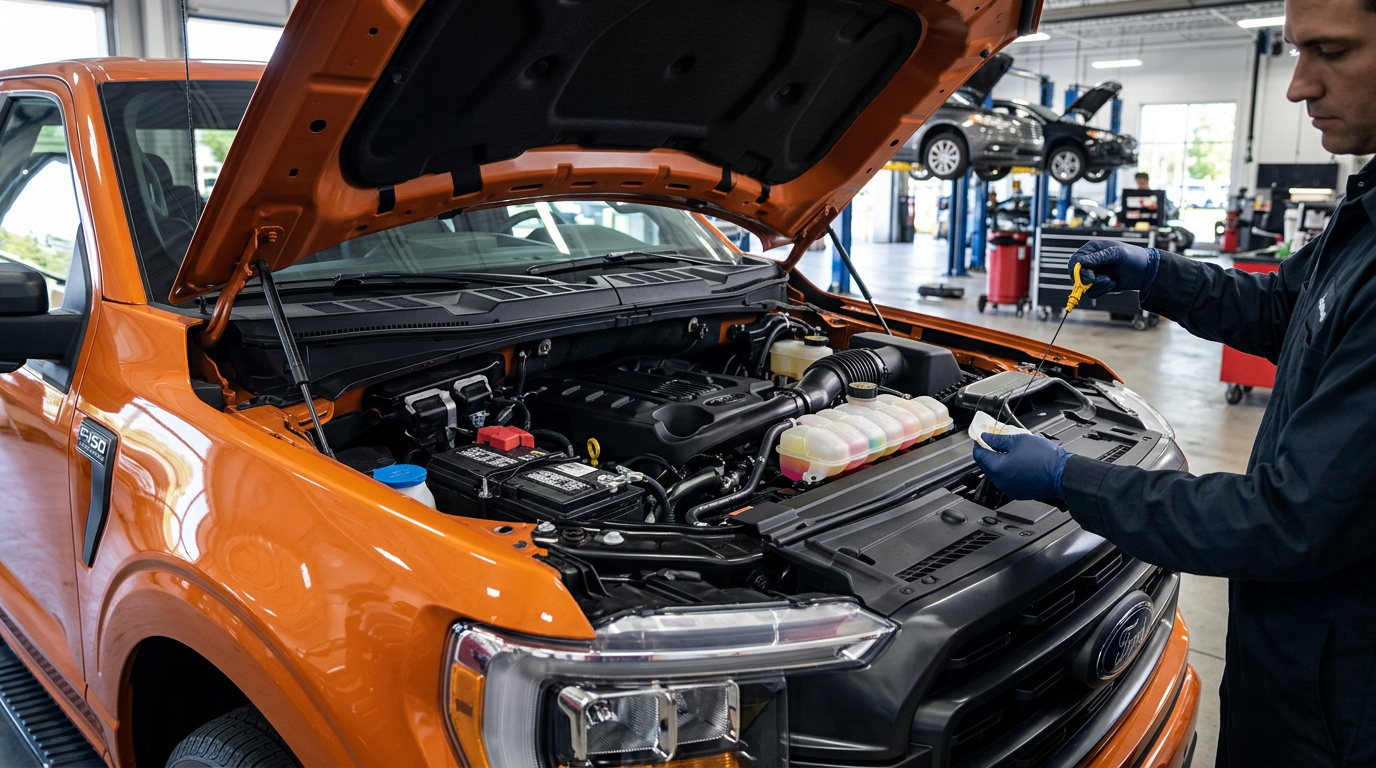 Check your engine oil and windshield washer fluid levels once a month and before heading out on long road trips. Other essential fluids—including brake fluid, engine coolant, transmission fluid, power steering fluid, and differential fluid—should be inspected during every routine multi-point service visit or according to the maintenance schedule in your vehicle's Owner's Manual.
Building regular checks into your vehicle care routine helps ensure long-term durability for your entire powertrain. For families hauling a boat out to Smithville Lake with a 2026 Ford F-150 or carrying cargo in a 2026 Ford Explorer, severe operating conditions like frequent trailering or prolonged idling mean checking fluid levels closer to monthly intervals.
Catching low or degraded fluids early prevents premature wear on critical internal components. When you bring your truck or crossover in for routine maintenance, factory-trained technicians perform a comprehensive multi-point inspection to evaluate every fluid reservoir under the hood and beneath the vehicle chassis. If you ever notice fluid spots under your vehicle or an unexpected warning light on your dashboard display, you can reach out by giving our team a quick call or get turn by turn directions to our service center location for a prompt evaluation.
Table of Contents
- What Are the 7 Critical Fluids to Check in a Ford Vehicle?
- How Often Should You Check Engine Oil Level and Coolant in a Ford?
- Why Does Ford Recommend Changing Brake Fluid Every Two Years?
- What Fluid Service Interval and Fluid Type Apply to Ford 10-Speed Transmissions?
- What Fluid Does a Ford Super Duty Differential Require and When Should You Service It?
- Common Questions About Ford Fluid Maintenance
- Keep Your Ford Running Strong with Smithville Ford, LLC
What Are the 7 Critical Fluids to Check in a Ford Vehicle?
The seven critical fluids to check in a Ford vehicle are engine oil, engine coolant, transmission fluid, brake fluid, power steering fluid, windshield washer fluid, and differential or transfer case fluid. Maintaining proper levels and fluid clarity across all seven systems protects vital components from excessive friction, heat, and internal corrosion.
Each fluid performs a distinct role in keeping your vehicle operating smoothly on everyday commutes and weekend trips:
- Engine Oil: Lubricates internal moving parts and carries heat away from the engine block.
- Engine Coolant: Absorbs combustion heat and prevents freezing or boil-overs in the radiator system.
- Transmission Fluid: Provides hydraulic pressure and cooling for seamless gear shifts in automatic transmissions.
- Brake Fluid: Transfers foot pedal pressure into hydraulic force at the brake calipers to stop your vehicle safely.
- Power Steering Fluid: Assists steering gear movement on models equipped with hydraulic power steering systems.
- Windshield Washer Fluid: Clears dirt, mud, and road spray from the front glass to maintain clear driving visibility.
- Differential and Transfer Case Fluid: Protects heavy-duty gears in rear axles and four-wheel-drive units under heavy load.
Using genuine Motorcraft fluids ensures exact chemical compatibility with your engine's internal gaskets, seals, and metallurgy. Drivers who prefer to perform minor maintenance at home can easily order genuine fluids and filters directly through our online parts store. If you are exploring an updated vehicle for your household, you can also look into reserving a new Ford model built with the latest Ford safety and engineering features.
How Often Should You Check Engine Oil Level and Coolant in a Ford?
Using the under-hood dipstick, you can accurately check your engine oil level monthly when the vehicle is on level ground and the engine is off. Factory-fill Motorcraft Yellow engine coolant requires replacement at 10 years or 200,000 miles, followed by replacement every 5 years or 100,000 miles for subsequent service intervals.
Checking engine oil monthly allows you to detect early oil consumption or minor leaks before internal engine wear occurs. Modern engines like the 3.5L EcoBoost V6 in the 2026 Ford F-150 or the 1.5L engine in the 2026 Ford Escape rely on clean, full-capacity motor oil to lubricate high-speed turbocharger bearings and timing components. To check the oil level accurately, pull the dipstick, wipe it clean with a lint-free rag, reinsert it fully, and pull it back out to verify that the fluid level sits between the minimum and maximum indicator marks.
Coolant levels should also be inspected visually at the clear expansion tank monthly. Never open a hot coolant reservoir cap, as pressurized hot liquid can cause severe burns. Driving over gravel back roads in Trimble exposes your engine bay to extra dust, making visual checks of cooling hoses and fluid clarity even more essential during seasonal transitions. If you notice your engine oil turning dark prematurely or your coolant level dropping steadily, consider scheduling a service appointment online to have our technicians inspect the cooling and lubrication systems.
Why Does Ford Recommend Changing Brake Fluid Every Two Years?
Ford recommends replacing brake fluid every two years because glycol-based brake fluid is hygroscopic, meaning it naturally absorbs ambient moisture from the surrounding air over time. Absorbed water lowers the fluid's boiling point and accelerates internal corrosion inside metallic brake lines, calipers, and anti-lock braking system valves.
Even in a closed braking system, microscopic moisture enters through rubber brake hoses and fluid reservoir vents. As moisture content rises above two percent, the fluid's boiling point decreases significantly. Under hard braking conditions—such as bringing a 2026 Ford Explorer carrying six passengers down steep hills—hot brake components can boil contaminated brake fluid, causing steam bubbles in the hydraulic lines. Because vapor compresses while liquid does not, this moisture accumulation causes a spongy brake pedal feel and reduced stopping efficiency.
Regular brake fluid flushes remove trapped moisture, metal wear particles, and degraded chemical additives. Replacing the fluid every 24 months preserves crisp pedal response and protects hydraulic components like the ABS module from internal rust. During a standard service visit, our technicians test the moisture content and clarity of your brake fluid to confirm whether a fluid flush is necessary.
What Fluid Service Interval and Fluid Type Apply to Ford 10-Speed Transmissions?
Ford 10-speed automatic transmissions require Motorcraft ULV (Ultra-Low Viscosity) Automatic Transmission Fluid meeting Ford specification WSS-M2C949-A. Under normal driving conditions, the recommended transmission fluid and filter change interval is 150,000 miles, which decreases to 60,000 miles under severe operating conditions like continuous heavy towing or commercial duty.
Modern transmissions, such as the 10-speed SelectShift® automatic paired with Ford truck and SUV engines, utilize ultra-low viscosity fluid to reduce internal fluid drag and maximize fuel efficiency. Using non-approved transmission fluid can damage internal friction clutches and compromise shift quality.
Our service team frequently notes that drivers ask whether sealed transmission systems can be checked at home. Because modern 10-speed units do not feature a traditional dipstick under the hood, checking fluid level requires raising the vehicle on a lift to access a dedicated check plug located on the side of the transmission casing while the fluid is at operating temperature. Due to the precise thermal expansion properties of Motorcraft ULV fluid and the requirement for specialized equipment, fluid level checks and service on sealed transmissions are best handled by certified technicians during routine maintenance visits.
What Fluid Does a Ford Super Duty Differential Require and When Should You Service It?
A Ford Super Duty rear differential typically requires Motorcraft SAE 75W-85 or 75W-140 Synthetic Rear Axle Lubricant meeting Ford specification WSS-M2C942-A or EST-M2C118-A. Standard differential fluid inspection is recommended at routine maintenance intervals, with fluid replacement scheduled every 150,000 miles under normal use or sooner if the axle is submerged in water or subjected to frequent heavy trailering.
Heavy-duty trucks carry substantial payload and generate extreme thermal loads in the rear axle gear sets. Differential gear oil lubricates the ring and pinion gear, differential bearings, and limited-slip clutch packs. High-performance synthetic lubricants maintain film strength under extreme pressure, preventing metal-to-metal contact when hauling heavy loads or towing equipment across Missouri highways.
If your truck drives through deep water while launching a boat or traversing flooded roads, water can enter the differential housing through the axle vent tube. Submerged axles require an immediate differential fluid drain and refill to prevent water-emulsion breakdown and rapid bearing failure. If you use your truck for heavy work, our service team can evaluate gear oil condition and replace differential fluid quickly when you stop by our service department location or call (816) 532-0800 to set up an appointment.
Common Questions About Ford Fluid Maintenance
Q: Can you check sealed transmission fluid levels yourself on a modern Ford?
Checking sealed transmission fluid yourself is difficult because modern Ford automatic transmissions lack an under-hood dipstick. Technicians must elevate the vehicle level on a shop lift and inspect fluid height via a casing check plug while the fluid reaches precise operating temperatures.
Q: What happens if Ford brake fluid gets contaminated or low?
Low or contaminated brake fluid leads to a spongy brake pedal feel, extended stopping distances, and potential ABS warning light illumination. Moisture contamination lowers the fluid boiling point and causes internal corrosion inside brake lines, calipers, and hydraulic pumps.
Q: How do I know if my Ford EcoBoost engine needs specialized oil?
Ford EcoBoost engines require motor oil meeting specific Ford material standards and viscosity grades detailed in your vehicle Owner's Manual. Synthetic-blend or full-synthetic Motorcraft oils protect high-speed turbocharger bearings and prevent low-speed pre-ignition in direct-injected engines.
Q: Does cold winter weather affect fluid inspection schedules?
Cold winter temperatures increase stress on vehicle systems and cause fluids like engine coolant and windshield washer fluid to work harder. Inspecting fluid levels before winter helps ensure proper antifreeze protection and prevents frozen washer fluid reservoirs.
Q: Is a multi-point inspection included with routine service at Smithville Ford?
Yes, our technicians perform a comprehensive multi-point inspection during routine oil changes and maintenance visits. We check fluid levels, inspect belts and hoses, evaluate tire tread depth, and check brake component condition to keep your Ford reliable.
Keep Your Ford Running Strong with Smithville Ford
Proper fluid maintenance is the single best way to ensure your Ford car, truck, or SUV delivers dependable performance for years to come. Whether you need a simple monthly engine oil check, a 24-month brake fluid replacement, or specialized 10-speed transmission service, our team is here to provide transparent care and genuine Motorcraft parts. Contact us or schedule your next service appointment online today to keep your vehicle running strong through every season.
© 2026 Smithville Ford, LLC. All rights reserved.