What is Included in Ford's 100,000-Mile Maintenance Service?
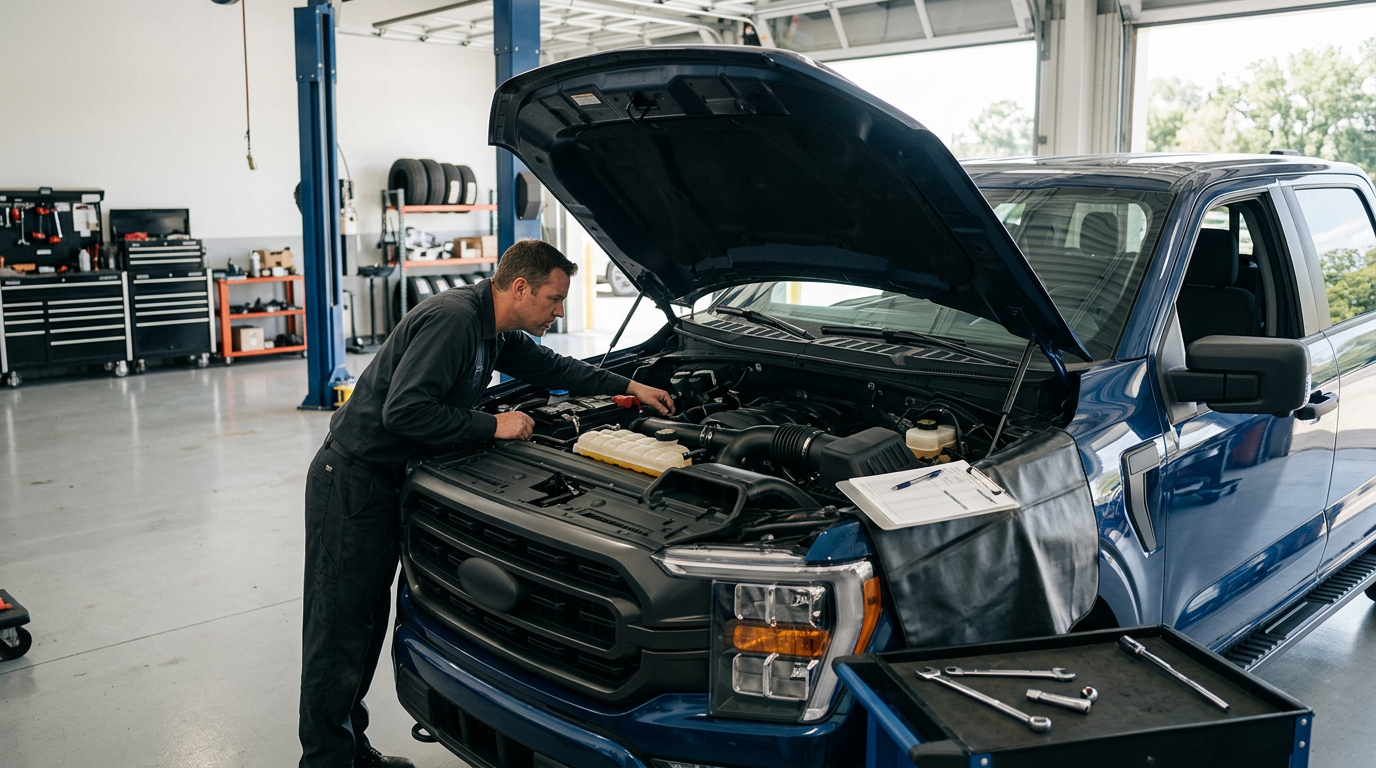 Ford's standard 100,000-mile maintenance service includes replacing the engine spark plugs, changing the engine air filter and cabin air filter, inspecting the accessory drive belts, and conducting a comprehensive inspection of the cooling system, brakes, steering, and suspension. On vehicles reaching 100,000 miles or 10 years of service, Ford also recommends flushing the engine coolant. Additional items, like transmission fluid or differential gear oil, may be serviced if the vehicle operates under severe duty conditions.
Reaching six figures on the odometer is a major milestone for any vehicle owner. For models like the 2026 Ford F-150 powered by the 3.5L engine paired with the SelectShift® transmission, proper care at this mark ensures that high 10,400 lbs towing capacity and working durability remain intact for many years ahead. While daily driving across Smithville involves a mix of highway miles and weekend trips hauling boats to the lake, maintaining clean engine airflow and precise ignition spark is essential to preserving performance.
During a typical 100,000-mile maintenance check, our factory-trained technicians perform several critical replacements and multi-point checks:
- Spark Plug Replacement: Worn electrode tips cause engine misfires and reduce fuel economy below standard EPA ratings like 17 city / 23 hwy on trucks or 20 city / 27 hwy on SUVs like the 2026 Ford Explorer.
- Engine and Cabin Air Filters: While engine air filters are routinely replaced every 30,000 miles and cabin filters every 20,000 miles, clean filters at 100,000 miles protect the intake system and HVAC evaporator.
- Engine Coolant Service: Ford specifies initial engine coolant replacement at 100,000 miles or 10 years (whichever comes first) using factory-approved yellow engine coolant formulas.
- Belt and Hose Inspection: Accessory drive belts are visually checked for cracking, fraying, or tension loss, ensuring reliable alternator and water pump operation.
- Comprehensive Brake and Suspension Check: Pads, rotors, shocks, struts, ball joints, and tie-rod ends are measured to ensure structural integrity and vehicle safety.
If your odometer is approaching six figures, you can easily book a maintenance appointment online with our certified team. If you want to drop off your vehicle or speak directly with our team, our service center location on US Highway 169 is convenient to reach, or you can give our technicians a quick phone call to discuss your mileage history.
Table of Contents
- Does the 100,000-Mile Service Include Replacing the Timing Belt or Timing Chain?
- When Should Ford Automatic Transmission Fluid and Engine Coolant Be Changed?
- How Long Do Turbochargers Last on Ford EcoBoost Engines and Do Spark Plugs Need Earlier Replacement?
- What Qualifies as Severe Duty Driving According to Ford Guidelines?
- What Parts Account for the Highest Expense During a 100,000-Mile Service?
- Common Questions About Ford 100,000-Mile Maintenance
Does the 100,000-Mile Service Include Replacing the Timing Belt or Timing Chain?
The 100,000-mile service on most modern Ford vehicles does not include replacing the timing mechanism because most current gasoline engines utilize a maintenance-free timing chain designed to last the full life of the engine. Only select Ford models equipped with a rubber timing belt specify a mandatory replacement interval, which typically lands at 100,000 to 150,000 miles depending on the specific engine design.
Determining whether your vehicle has a timing chain or timing belt comes down to engine architecture. Popular modern powertrains—including the 2.3L engine in the 2026 Ford Explorer, the 3.5L V6 in full-size trucks, and most EcoBoost designs—use metal timing chains enclosed behind heavy metal timing covers. These chains are lubricated directly by engine oil and require no scheduled replacement as long as oil change intervals are strictly observed.
Conversely, select smaller displacement engines, such as specific non-turbocharged four-cylinder variants or older engine families, may feature an exterior or wet-style rubber timing belt. These belts are protected by plastic timing covers. Over thousands of heating and cooling cycles, rubber compounds gradually degrade, crack, and lose tensile strength. If a rubber timing belt snaps, interference engines can suffer severe valve-to-piston impact, causing catastrophic internal mechanical damage.
To verify what your vehicle uses, you can inspect the front of the engine assembly or review the technical specifications section in your Ford Owner's Manual:
- Metal Front Cover: Indicates a timing chain system that relies on clean engine oil for tensioning and lubrication.
- Plastic Front Cover: Indicates a dry timing belt system that requires periodic replacement per the maintenance schedule.
- Wet Belt Systems: Some specialized smaller engines submerge the timing belt in oil, requiring strict oil specification adherence and designated service intervals.
Our technicians inspect timing cover seals and tensioner operation whenever performing high-mileage engine services to confirm there are no oil leaks affecting internal timing components.
When Should Ford Automatic Transmission Fluid and Engine Coolant Be Changed?
Ford official maintenance schedules recommend changing automatic transmission fluid and filter at 150,000 miles under normal driving conditions, while engine coolant requires its initial flush at 100,000 miles or 10 years of operation. However, driving conditions that involve heavy towing, prolonged idling, or frequent stop-and-go travel significantly shorten the recommended transmission fluid change interval to between 30,000 and 60,000 miles.
Modern multi-speed transmissions, such as the automatic 8-speed found in the 2026 Ford Escape or 10-speed SelectShift units, operate under precise electronic pressures and tight mechanical tolerances. Thermal breakdown of transmission fluid causes varnish buildup, delayed gear engagement, and harsh shifting. While 150,000 miles is listed for light-duty highway commuters, vehicles that haul heavy cargo or tow trailers experience higher internal fluid temperatures that shorten fluid viability. Changing transmission fluid and replacing the internal filter around 60,000 to 100,000 miles provides extra protection for planetary gearsets and torque converters.
Engine coolant maintenance follows a strict chemical timeline. Modern Ford vehicles utilize specialized yellow engine coolant formulations engineered for long-term corrosion protection. Over time, anti-corrosion additives degrade, allowing rust, scale, and mineral deposits to build up inside the radiator, heater core, and internal engine passages.
Following the initial 100,000-mile flush, Ford specifies subsequent coolant flushes every 50,000 miles or 5 years. Replacing old coolant prevents water pump impeller erosion, maintains proper cabin heat output during cold months, and protects aluminum engine blocks from electrolysis.
How Long Do Turbochargers Last on Ford EcoBoost Engines and Do Spark Plugs Need Earlier Replacement?
Ford EcoBoost turbochargers are designed to last 150,000 miles or more when routine oil changes are performed consistently, but the spark plugs in these turbocharged engines frequently require replacement earlier than 100,000 miles. Due to higher cylinder pressures and elevated combustion chamber temperatures, spark plugs in turbocharged engines often need service every 45,000 to 60,000 miles.
The high-durability design of EcoBoost turbochargers relies heavily on constant, clean oil circulation to cool and lubricate internal turbine shaft bearings spinning at over 100,000 RPM. When synthetic engine oil is replaced at proper intervals, turbocharger failure is exceptionally rare before reaching very high mileage milestones. Allowing engine oil to break down or run low, however, creates carbon sludge that starves turbo oil feed lines and causes premature shaft bearing play.
Because forced induction pushes denser air-fuel mixtures into the cylinders, ignition spark plugs work significantly harder in turbocharged engines compared to naturally aspirated engines. Over time, high cylinder pressure widens the spark plug gap, leading to several noticeable symptoms:
- Mild engine hesitation under heavy acceleration or while towing.
- Misfires under load that trigger check engine light codes.
- Noticeable drops in overall fuel economy below rated figures like 26 city / 32 hwy.
- Rough idling during initial cold engine starts.
For vehicle owners who prefer performing minor upkeep or purchasing genuine OEM components for their high-mileage vehicles, sourcing factory-spec Motorcraft spark plugs through our online Ford parts department guarantees exact electrode gaps and heat ranges designed specifically for your engine family.
What Qualifies as Severe Duty Driving According to Ford Guidelines?
Ford service guidelines define severe duty driving as operating conditions that subject a vehicle to frequent short trips, prolonged engine idling, heavy towing, driving in dusty environments, or operating in extreme hot or cold temperatures. When a vehicle meets severe duty criteria, Ford recommends shortening maintenance intervals for engine oil, spark plugs, transmission fluid, and drive belts.
Many vehicle owners assume severe duty applies only to commercial work trucks, but routine daily usage often falls under severe guidelines. For instance, drivers navigating agricultural surroundings around Trimble often travel down dusty gravel back roads and idle engines frequently during farm chores or school drop-offs. Dust particles penetrate air filters faster, while low-speed operation reduces ambient airflow through coolers and radiators.
Specific operating conditions that classify as severe duty include:
- Short Commutes: Frequently driving trips under 10 miles in freezing weather prevents engine oil from reaching full operating temperature, allowing moisture and raw fuel to contaminate the crankcase.
- Towing and Hauling: Pulling heavy trailers near maximum limits—such as utilizing the 5,000 lbs towing capacity on a 2026 Ford Explorer or 2,000 lbs limit on a 2026 Ford Escape—generates intense thermal stress on engine oil, transmission fluid, and differential gears.
- Off-Road and Gravel Travel: Driving on unpaved roads forces air intake filters, cabin filters, and suspension bushings to absorb heavy particulate loads.
- Excessive Idling: Operating auxiliary power systems like Pro Power Onboard or letting engines idle for extended periods accumulates engine run hours without adding mileage to the odometer.
Under severe duty schedules, spark plug changes shift from 100,000 miles down to 60,000 miles, accessory drive belt inspections move from 100,000 miles down to 60,000 miles, and automatic transmission fluid changes drop to 30,000–60,000 mile intervals.
What Parts Account for the Highest Expense During a 100,000-Mile Service?
Labor costs for spark plug replacement on tight V6 engine configurations and specialized fluid replacement fluids account for the largest portion of expenses during a 100,000-mile service appointment. While routine inspections and air filter replacements are quick and affordable, servicing deep-engine components and high-tech drivetrain fluids requires extensive technician labor and premium materials.
Replacing spark plugs on modern V6 or V8 engines is significantly more complex than on older, naturally aspirated four-cylinder vehicles. On transverse V6 engine setups found in many crossover SUVs, reaching the rear bank of spark plugs requires removing the upper intake manifold, plenum gaskets, fuel injector wiring harnesses, and vacuum lines. This teardown and reassembly process adds multiple hours of labor to ensure all intake seals seat perfectly without vacuum leaks.
Specialty fluid costs also contribute noticeably to high-mileage maintenance totals:
- Motorcraft Super Plus Coolant: Complete flushing of dual-pass cooling systems requires multiple gallons of concentrated long-life coolant combined with deionized water flush procedures.
- Mercon ULV Transmission Fluid: Advanced multi-speed automatic transmissions utilize low-viscosity synthetic fluids that carry higher per-quart material costs compared to traditional automatic transmission fluids.
- Transfer Case and Differential Oils: Four-wheel drive and all-wheel drive models require specialized synthetic gear lubricants for front differentials, rear drive units, and transfer cases.
Investing in these scheduled replacements at 100,000 miles prevents far costlier mechanical repairs down the road. Replacing worn spark plugs prevents ignition coil failure and catalytic converter damage, while fresh coolant protects expensive aluminum cylinder heads from internal warpage or corrosion.
Common Questions About Ford 100,000-Mile Maintenance
Q: How do I confirm what service items my specific Ford model needs at 100,000 miles?
The precise maintenance schedule for your vehicle is detailed in the scheduled maintenance section of your Ford Owner's Manual or accessible via your Ford account online using your 17-digit vehicle identification number (VIN). You can locate your VIN stamped on the lower driver-side corner of the windshield or on the driver-side doorframe sticker. Because maintenance tasks differ between naturally aspirated engines, turbocharged powertrains, and hybrid models, verifying your exact model year and engine code ensures you follow correct factory intervals.
Q: Is brake fluid replacement included in the 100,000-mile maintenance check?
Brake fluid service is tracked by calendar time rather than mileage, with Ford recommending a complete brake fluid flush every three years regardless of miles driven. Hydraulic brake fluid is hygroscopic, meaning it absorbs moisture from ambient air over time. Moisture contamination lowers the boiling point of the fluid and leads to internal corrosion of anti-lock brake pump valves and brake calipers. If your vehicle reaches 100,000 miles and has not had its brake fluid changed within three years, adding a fluid flush to your appointment is highly recommended.
Q: What happens if I delay replacing my spark plugs past 100,000 miles?
Delaying spark plug replacement causes the electrode gap to erode beyond factory specification, forcing ignition coils to work significantly harder to generate a spark. This extra electrical strain can burn out individual coil-on-plug units, resulting in sudden engine misfires, rough acceleration, and unburned fuel entering the exhaust system. Unburned fuel entering hot catalytic converters can melt internal ceramic substrates, leading to thousands of dollars in exhaust repairs that far outweigh the cost of timely spark plug service.
Q: Should transfer case and differential fluids be changed at 100,000 miles?
While Ford standard maintenance schedules list long-life intervals for four-wheel drive and all-wheel drive gear oils under normal highway driving, changing transfer case and differential fluids at 100,000 miles is best practice for severe duty use. Vehicles that tow trailers, haul heavy bed loads, or navigate slippery mud and winter roads subject gear lubricants to high shear forces. Replacing old gear oils removes microscopic metal wear particles and ensures smooth power distribution to all four wheels.
Q: Does a 100,000 mile service take a full day to complete at the dealership?
A comprehensive 100,000-mile maintenance package typically takes a full day in our service department to perform all required inspections, spark plug replacements, and specialized fluid flushes. To keep your day moving without interruption, we offer convenient transportation options—including complimentary Pick-Up & Delivery and loaner vehicles, subject to availability. Scheduling your appointment in advance allows our technicians to allocate proper bay time, pre-order exact factory filters and fluids, and reserve your preferred transportation option.
Keeping your truck or SUV performing at its best for the next 100,000 miles begins with genuine factory service. To protect your investment and maintain complete confidence on every journey, learn about our long-term vehicle protection coverage, or speak directly with our service team by giving us a direct phone call. When you are ready for your appointment, visit our service desk in Smithville where our certified technicians are ready to take expert care of your vehicle.
© 2026 Smithville Ford, LLC. All rights reserved.